In an effort to make this 5 day trip less daunting for you to read about, I'm going to outline & number the itinerary and then separately provide details about each number. If you just wanna know more about certain numbers, you can just read that & skip the rest. Like some of my other posts, I'll provide wikipedia links, if you wanna learn more about something Pictures are at:
Egypt- Dec. 2008.
Sun, Dec. 21:
1) 14.5 hour journey from Tel Aviv to Cairo
Mon, Dec. 22 (CAIRO):
2) ancient capital of Egypt-Memphis
3) ancient capital of Egypt & first pyramid- Sakkara
4) carpet weaving school
5) papyrus plant/gallery
6) Great Pyramids of Giza
7) camel ride
8) Sphinx
9) perfume plant/gallery
10) free night "on the town"
Tues, Dec. 23 (CAIRO):
11)
Egyptian Museum12)
Hanging Church13)
Ben Ezra synagogue14) Old Cairo Bazaar
15)
Citadel of Muhammed Ali (not the boxer)
16) Cairo (tourist) market
17) Dinner on the Nile
Wed, Dec. 24 (ALEXANDRIA):
17) Drive to Alex,
Quaitbay Fort, finding a personal cabbie for the day
18)
Montaza Palace and Gardens19) Area of 13 Mosques
20)
Kom al-Shuqafa Catacombs21)
Pompey's Pillar / driving through the market
22)
Bibliotheca Alexandrina / drive back to Cairo
Thurs, Dec. 25:
23) 13 hour journey from Cairo to Tel Aviv
DETAILS1) My friend, Shari & I met at the tour office at 10 am and got in the van. There were a bunch of other people there, but had just organized transportation to Cairo through the company. We were the only ones that were actually going on the tour. By the end of the ride, though, another couple decided to join us for the first day. They were about our age, maybe a few years older. The guy (Tristan) was from Canada, the girl (Arunima) from India, but both have been living in LA for a while. There was also another guy, Will, who was about 20 years old, had aspirations to do humanitarian work in Northern Africa and was possibly in the Navy. He's also swimming the English Channel next summer. We started talking to him at the first stop in Israel on the way to Eilat because we thought the van left us. But then we saw him and were calmed. It just went to get gas. We spent about 2 hours at the border. FUN! Arunima was having some problems w/ her Indian passport & non-reentry Israeli visa. She got in, but we don't know if can get back into Israel. We stopped in Sinai to eat at a little place in a little, nameless town in the middle of the desert. Shari (from NY), compared the
Suez Canal tunnel to the
Brooklyn Battery Tunnel. We got to our hotel in Cairo, the Indiana, at about 12:30 pm. The guy that "helped" us to our room found out we were from the States and proudly informed us that Indiana was a state in the US. Yes. It is. Thank you.
2) We met our tour guide, an Egyptian Christian named Michael, picked up Tristan and Arunima and went to
Memphis. Not in Tennessee, which was most likely named after the ancient Egyptian city. Because it definitely is not the other way around. At this point, Shari & I couldn't remember Arunima's name & kept listening closely to Tristan, hoping he'd address her by name. He finally did hours later and Shari quickly & sneakily wrote it down in her journal that she had been taking notes in. Anyway, Memphis was the first capital of Egypt, during the old kingdom (5000 BCE-2500 BCE). It is just outside the city of Cairo and to get there we had to navigate through the 2.5 million cars that are on the roads daily, all traveling together, without traffic lights or noticeable signs/laws. To quote Michael: "We used to have traffic lights..." We drove through a really poor area town that has a few resort-like hotels, because apparently the rich go there to "get away from the city life". Memphis was founded by King Menas, who united Upper and Lower Egypt. Now there is an open air museum there with a lying, feetless statue of Ramses II (found in Luxor) and a small Sphinx and a standing Ramses statue, among other things. Ramses II was king/pharaoh when Moses came to Egypt & he "raised" him. He married 52 women and had 125 children. We were gonna see lots of statues so Michael said the kings were identified by a crown with a cobra on it and a beard. A tall crown was a symbol of Upper Egypt, as was the lotus plant. A round crown and papyrus plant was symbolic of Lower Egypt. And to clarify, since the Nile flows south to north, Upper Egypt is in south and Lower Egypt is north. Clear as mud, right? I'm glad Shari took notes! We also learned some hieroglyphics/ancient Egyptian: ra= sun, (m)ses=son, mo=water, mas=born. SO: King Ramses was naturally the Sun King, Moses was the Water Son and now we know exactly why Christmas is called Christmas. Names, especially of a king, were written in a oval called a cartouche. Also, all standing statues depict the person with their left foot forward (also like some of the Greek statues I saw in Athens), to show that they are reading to step into the afterlife.
3) In
Saqqara, Egypt's second capital, also during the Old Kingdom, we saw the first pyramid ever built. It is a step pyramid, with 6 equal sized levels, for Pharaoh Djoser (AKA: Zoches). It took 20 years, about 100,000 workers and 1 million (yes, they were counted) limestone and mud bricks. It's about 65 meters (213 ft) high. The first level was originally used as a very big bench. Nothing was found inside. We still don't know where he's buried. To get to it, you first walk through the Unification Temple/Funerary Complex. There were 22 columns on each side, representing all 44 states in Egypt at the time. Everything was created by a wise man/architect named Imhotep (meaning "in peace"), who was apparently the father of medicine and the first to ever use limestone.
4) In Saqqara, we learned about Egypt's education system. There is not country-wide, compulsory system and so, in Saqqara, a place with many farmers, many kids do not go to school and do not get educated at all. So, Egypt built these carpet weaving schools, that don't cost the families anything. Besides hand-weaving carpets, students learn very basic reading & math skills and also make some money from their efforts. We visited one of the schools. Their fingers FLY on these carpets and the strings are so small. I really don't know how they do it.
5) Next, we visited a
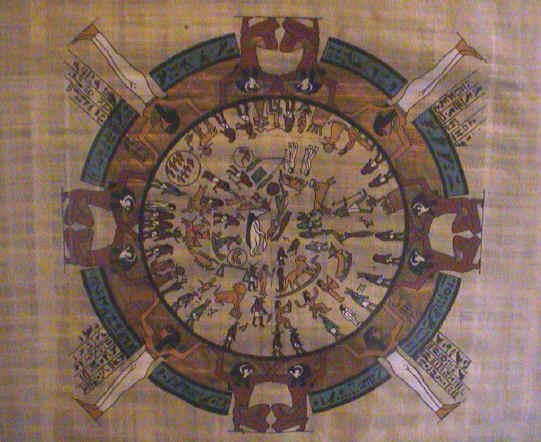
papyrus gallery, where we learned how the first paper was made. It was very strong...even more so than today's paper. Ancient books written on it and stored in scrolls and art was painted using raw egg & plant dyes. Now, oil paints are used. We learned about the ancient
Egyptian calendar, which was greatly influenced by the Greeks in later times. I aced the "quiz" on it. It is circular and has 4 images like a compass to stand for the directions. The 4 diagonal images stand for the 4 seasons, There are 12 figures, total, around the circle for the month, holding the circle with 24 hands, for the hours in a day. There are also symbols for the 7 days of the week, 52 weeks in a year, all totaling 365 for the days in a year. It's interesting to see how these ancient cultures wanted to symbolically represent time. The Treasury building in Petra, Jordan did something similar.
6) Finally! We got to visit the
Great Pyramids in Giza, just outside of Cairo! They're the only remaining monument on the Seven Wonders of the Ancient World list. There are three in a row, of decreasing size and behind the last are three small pyramids in a row. The biggest is the
Pyramid of Khufu (481 ft, 2.3 million limestone blocks), the middle is the
Pyramid of Khafre (471 ft, limestone) and the small one is the
Pyramid of Menakaure (218 ft, limestone and granite). The 3 small pyramids are thought to be unfinished and for the queens. The Pyramid of Khafre looks the biggest, because it is on elevated land and is the only one that still has part of its casing stones at the top. Erosion has left the others with just their base stones. Like going to see any world site that everyone talks about, I was worried that they would live up to expectations. But, they were really amazing. It's incredible to think that people built them without machines. I mean each block weighed about 2 tons and there were millions of them! AND they were built just to be a king's tomb. Thousands of lowly civilians labored for 20 years or so in preparation for their king's death. If they died, they just got a regular old burial, without a headstone. They were thought to be paid laborers, even if very minimally, though, and not slaves. In fact, according to Michael and Hadassah magazine (Thanks for the article, Grandma), the Jews did not built the pyramids. Bubble bursted! They were there for at least 1000 years before the arrival of Joseph (the first Jewish slave in Egypt). The Jews, instead, built the ancient cities of
Pithom and Ramses.
7) We bargained hard core, with the help of our tour guide to go on a 1/2 hour camel ride behind the pyramids. These 2 young boys (maybe around 10-12) led our camels. Their English was decent for a country that doesn't have a mandatory education system. Probably from all the tourists...I actually couldn't see them having much of a conversation beyond the necessities for their job. This was my 3rd time on a camel, but it was still pretty cool. Very, very bumpy. I took a video that I will try to post, also. They are wider than horses, especially w/ the blankets and saddle. I was sore the next day!
I took a break from writing this & came back & realized how long this is/how ridiculous it is to go through details about everything. Look at the pictures, check out the itinerary above that I linked to Wikipedia & let me know if you have questions or what more details on specific things.